
Real school, real science: The MBP Squared project
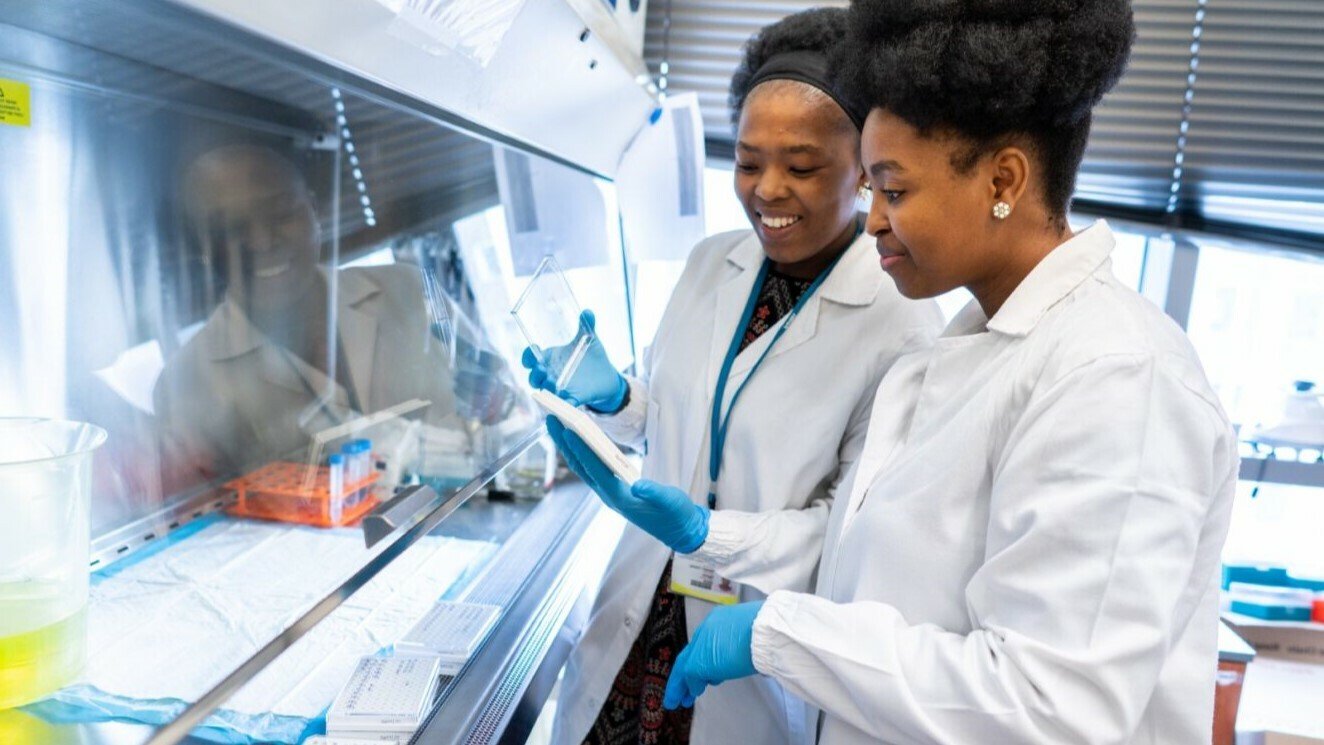
For a few days in the school year, the Simon Langton Grammar School in Canterbury does something a bit different. In collaboration with researchers from the University of Kent, sixth form students take part in real scientific research.
Pioneered by their teacher, Dr Dave Colthurst, the students have been working to clone a gene implicated in Multiple Sclerosis (MS). The students use real laboratory equipment, picking up actual scientific techniques from practicing researchers, and experiencing what bench research is really like.
The following is a photo, video and audio blog of one exhausting, but exhilarating, day in September.
Welcome to the Simon Langton Grammar School. But we’re not here for lessons; today, we’re here for science!
![]() |
![]() |
You know you’re in a lab when the fridge is labelled like this…
It’s not just biology they do here. The science department is working with CERN to feed real data to physics projects. Find out more at the Star Centre website.
But back to biology. The MBP Squared project is an exciting opportunity for the school’s A-level students to take part in real scientific research.
This is the man responsible for it all: Dr Dave Colthurst, also the school’s ‘Researcher in residence’. Here he is preparing his slides for the introductory assembly…
And this is the reason for the project. When Dr Colthurst’s wife was diagnosed with multiple sclerosis, he used his training as a former biochemist to start the MBP Squared project, investigating a gene implicated in the disease.
For the last couple of years students, teachers and researchers have been working together to clone the MBP (Myelin Basic Protein) gene and grow up stocks of the gene, and its resulting protein, for experimental use.
Here’s Dr Colthurst explaining their progress:
There’s plenty to be done, so let’s get started! First, the introductory assembly.
And here’s what we have in store for us. Today’s goal is to transform yeast and E.coli bacteria with the MBP gene in order to produce stocks of the MBP protein.
Then it’s off to class. The students separate into groups and are briefed by their teachers and supervisors — volunteer PhD and postdoctoral researchers from the University of Kent.
It’s then time to don lab coats and fire up the bunsen burners.
![]() |
![]() |
First up, the Saccharomyces cerevisiae group and E. coli teams. Their job is to prepare stocks of bacteria and yeast to help bulk up stocks of the MBP protein itself. The E.coli team treat the bacteria so that it is able to take up plasmids (small rings of DNA) to get the MBP gene into the bacteria.
![]() |
![]() |
The groups prepare media and agar plates for use later in the day. They sub-culture cells and prepare competent cells, which will then be transformed with the MBP plasmid. They also prepare glycerol stocks for longer term storage of the E.coli bacteria carrying the MBP plasmid, and practice streaking plates (for growing the bacteria) using asceptic technique.
|
![]() |
|
![]() |
Each of the groups is supervised by a University researcher. But each of the teams are led by year 13 students who took part in the project the year before. This ensures that the skills get passed on from year to year, and also gives the seniors more responsibility and the chance to really get to grips with the work.
Elsewhere in the lab, the DNA purification and analysis team are purifying the plasmid DNA.
|
![]() |
|
|
![]() |
Once purified, the team cut up the plasmids with restriction enzymes and running samples on agarose gels to see if the plasmid really does contain the MBP gene. They also create new plasmids ready for future use.
![]() |
![]() |
![]() |
![]() |
Elsewhere, the Bioinformatics team are searching DNA sequence databases to determine what results the lab teams might expect to see (for example, the bands they might see on their gels). Their findings also help direct future experiments for the project.
![]() |
![]() |
A quick break for lunch and a group photo.
Then swiftly back to the lab. The Protein purification group are hard at work. They are using specialist kits to purify tagged proteins (hopefully MBP).
Similar to the DNA team, the protein samples must be run their samples on gels (though this time protein and not DNA) to check if the MBP is actually there. Those gels are run by the Western blotting team.
![]() |
![]() |
![]() |
![]() |
![]() |
The Western blot technique involves separating out the protein on an SDS-PAGE gel, then incubating it overnight in an antibody wash. The antibody sticks to the MBP protein, and thus helps visualise whether the MBP has been produced, and whether the project’s efforts have been successful.
![]() |
![]() |
![]() |
Each of the groups work is vital to today’s goal of expressing the MBP gene, and producing stocks of the MBP protein for future experiments.
The day finishes up with a plenary session for all groups, with the team leaders reporting back on what they did and what they’ve achieved today.
More information on the project is available on the MBP Squared website.
The MBP2 project is funded by a People Award from the Wellcome Trust.


Trackbacks