
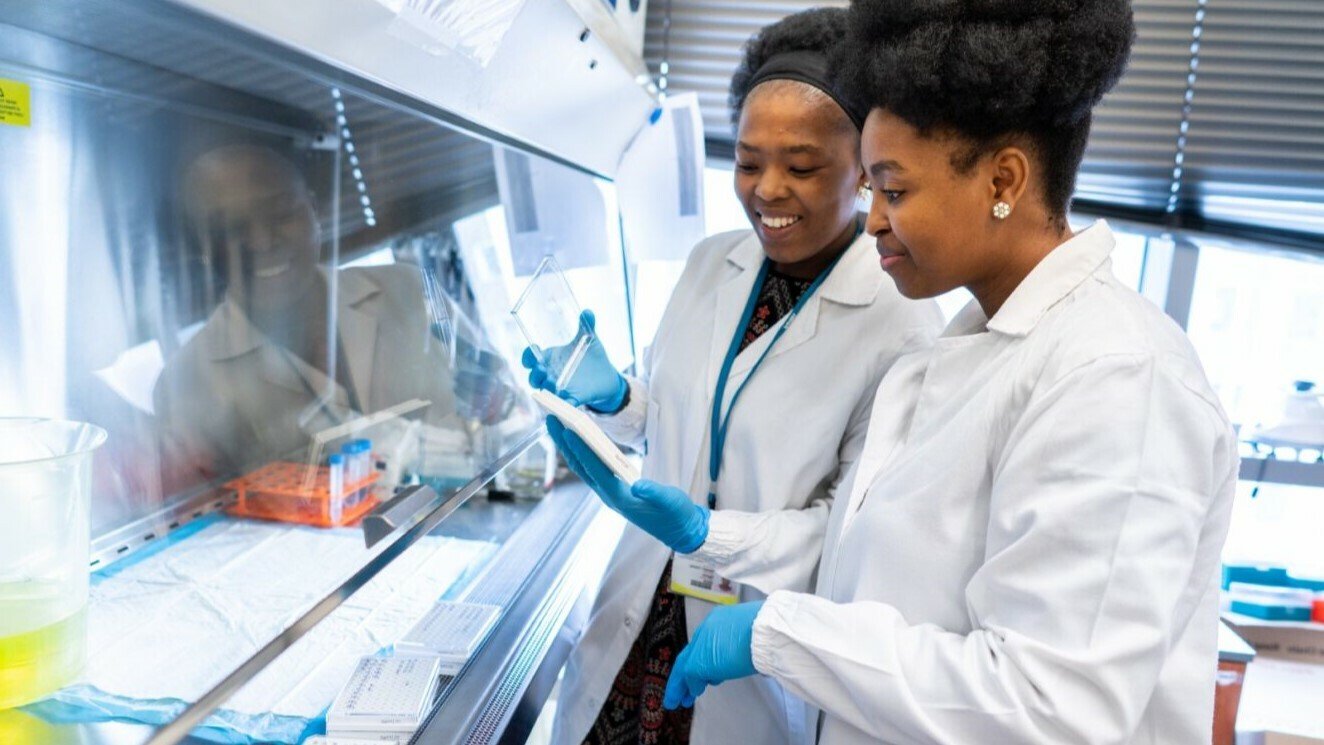
Education, Education, Education
Why do we care about science education? Because it is impossible to have extraordinary science without extraordinary scientists and a public eager to understand and gain from their work, says our Head of Education and Learning, Hilary Leevers.
I joined the Wellcome Trust last year and, despite an awful lot of background reading, it wasn’t until I worked here that I realised just how much the Trust does to support and improve education and learning. The showreel above gives just a taster of many of the different elements of that work.
Championing the development of highly skilled and valued teachers is a major strategic priority for us. The ways in which our work supports this priority illustrates the different approaches that we take to our work.
We know that teachers are at the heart of a good education, a point reinforced by the results of the Wellcome Trust Monitor. Around half the young people surveyed said that having a good teacher had encouraged them to learn science, but half also identified a bad teacher as something that had put them off.
We have commissioned further research to better understand how to support teachers throughout their careers and across all stages of education.
For instance, one of our recent reports highlighted the variability in the science content of initial teacher training, while another identified the key concerns of primary school science teachers.
We use these findings to develop recommendations for improvements, testing them as much as possible, and working with like-minded organisations and the Government to achieve them.
As an independent funding body, we’re also able to directly support improvements. Hence, the Trust funded the foundation and building of the National Science Learning Centre in York, enabling the professional development of science teachers and technicians throughout the UK. And, recognising there’s more to it than ‘if you build it, they will come’, welater teamed up with the Government and industry partners to form Project ENTHUSE, which provides bursaries for the course fees and associated costs needed to get the training to the teachers who need it.
We also support teachers by providing high-quality resources on the latest science. This sometimes takes the form of major initiatives, such as In the Zone, which will see us sending an investigative experimental kit inspired by the London 2012 Olympic and Paralympic Games to every school and further education college in the UK. But we also fund innovative and exciting education projects through our Public Engagement Awards.
We don’t do that in isolation though. We work with local Camden schools around our headquarters, partly as a way of investing in our community, but also because these relationships help us to ground our work.
Education, like science, is an area that’s ever changing and we’re doing our utmost to keep up with the latest issues and innovations. Our Education Strategy for 2010-20 identifies three focus areas: primary science, informal learning and the interface between neuroscience and education. We have a relatively good understanding of the first, having, among other things, supported whole school improvement through the Primary Science Quality Mark. And we are planning further work to lift the subject expertise of primary science coordinators.
Our work on informal learning concerns the science learning that occurs outside of schools and other traditional education contexts. We have commissioned two reviews to better understand current practice and opportunities. We’ve just started developingour work on neuroscience and education, which promises to be a fascinating area.
Please do get in touch if you have any comments about what we’ve done or what you think that we should be doing. You can contact us directly at education@wellcome.ac.uk
The Wellcome Trust has a long-standing enthusiasm and commitment to excellent science education for all. This is because it is impossible to have extraordinary science without extraordinary scientists and a public eager to understand and gain from their work.
The future of science depends on the quality of science education today.
Hilary Leevers
Hilary Leevers is Head of Education and Learning at the Wellcome Trust


Trackbacks